Where Is Prosecco Made? DOC, DOCG and Superiore Explained
Prosecco is made in north-east Italy, in 9 provinces of Veneto and Friuli Venezia Giulia. Most of it is Prosecco DOC from the plains. The top level, Conegliano Valdobbiadene Prosecco Superiore DOCG, comes only from 15 hill communes in the province of Treviso, and its best-known hill, Cartizze, covers just 107 hectares.

On this page
The three Prosecco names on a label
All three denominations were set up on 17 July 2009, when the “Prosecco system” was reorganised (Consorzio Prosecco DOC).
| Name on the label | Where | What it means |
|---|---|---|
| Prosecco DOC | 9 provinces in Veneto and Friuli Venezia Giulia | The large area. Most Prosecco in shops. At least 85% Glera. Rosé allowed (10–15% Pinot Nero) |
| Conegliano Valdobbiadene Prosecco Superiore DOCG | 15 hill communes in the province of Treviso | The hills this site covers. A DOC since 1969, DOCG since 2009 |
| Asolo Prosecco DOCG | Hills around Asolo and the Montello, also in Treviso province | The second DOCG, south-west of Valdobbiadene across the Piave river |
Inside Conegliano Valdobbiadene there are two finer levels:
- Rive: wine from a single commune or hamlet, named on the label (for example “Rive di Col San Martino”). There are 43 Rive: 12 communes and 31 hamlets (Italian Wine Central).
- Superiore di Cartizze: a 107-hectare sub-zone on the hills of San Pietro di Barbozza, Santo Stefano and Saccol, in Valdobbiadene (Consorzio). See the Cartizze page.
The 15 DOCG communes
The production rules name them: Conegliano, San Vendemiano, Colle Umberto, Vittorio Veneto, Tarzo, Cison di Valmarino, San Pietro di Feletto, Refrontolo, Susegana, Pieve di Soligo, Farra di Soligo, Follina, Miane, Vidor and Valdobbiadene.
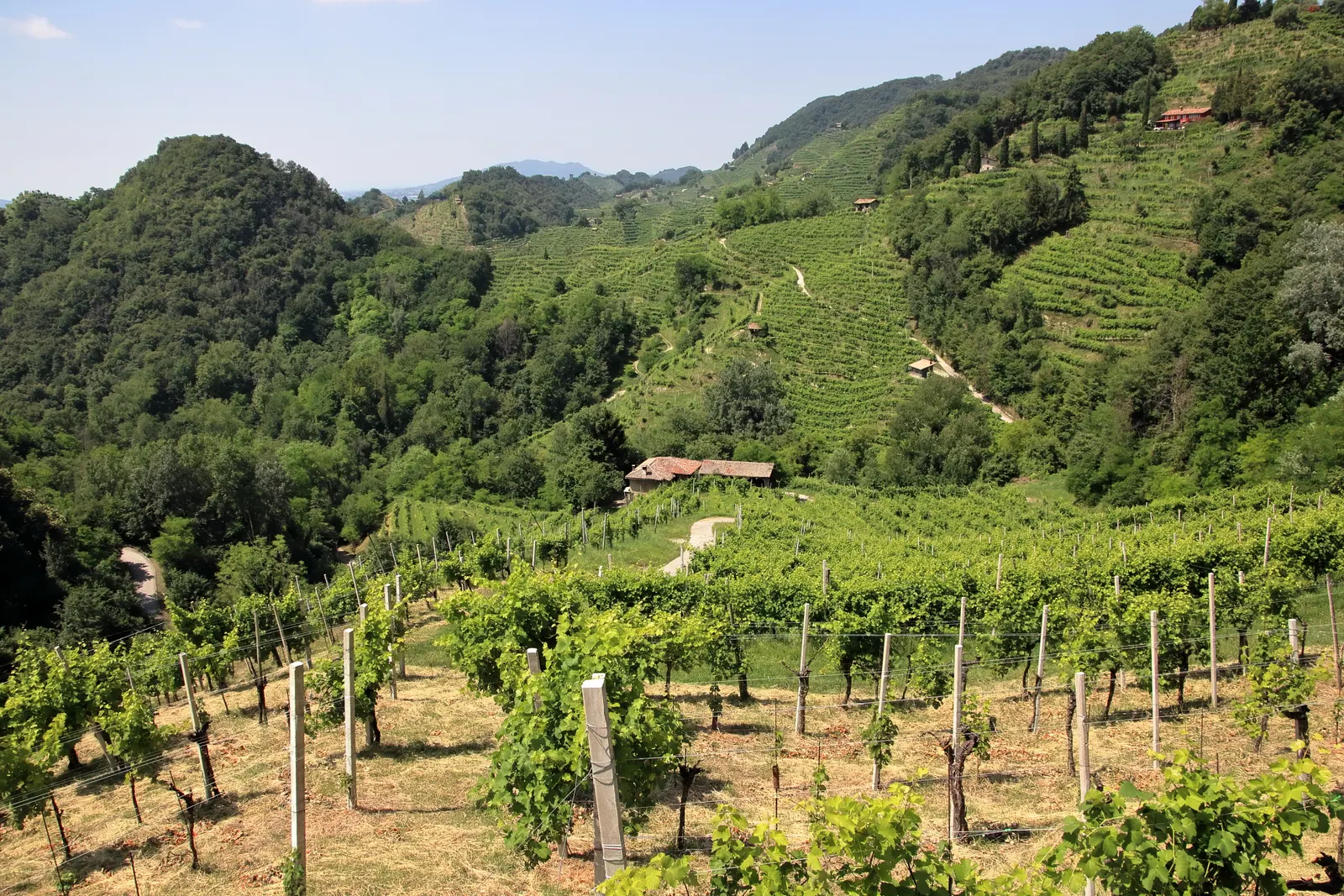
That’s the area to visit. The UNESCO World Heritage site, listed in 2019, covers the heart of it. Its core zone runs through 12 communes from Valdobbiadene to Vittorio Veneto. Conegliano is in the buffer zone (UNESCO site management).
Why the hills matter
UNESCO lists the hills for their landscape: steep “hogback” ridges, and ciglioni, small plots of vines on narrow grassy terraces, used since the 17th century. It also names the bellussera, a vine-training system developed around 1880. On slopes this steep, much of the vineyard work is done by hand.
Sweetness: Brut, Extra Dry, Dry
The terms look backwards: Extra Dry is sweeter than Brut. EU limits for sparkling wine, per litre of residual sugar:
| Label | Sugar (g/L) | Taste |
|---|---|---|
| Brut Nature | 0–3 | Bone dry |
| Extra Brut | 0–6 | Very dry |
| Brut | 0–12 | Dry |
| Extra Dry | 12–17 | Off-dry |
| Dry | 17–32 | Noticeably sweet |
The Conegliano Valdobbiadene consortium lists its sparkling styles as Extra Brut, Brut, Extra Dry and Dry. It also lists a Sui Lieviti, fermented in the bottle and left on its lees, which is Brut Nature (Consorzio).
What this means for a visit
- Stay in the DOCG hills. The famous landscapes, the steep vineyards and the family wineries are between Conegliano and Valdobbiadene.
- Ask for a Rive and a Cartizze. Tasting the same grape from different hills is the point of a visit.
- Try a Sui Lieviti. It’s bone dry and cloudy from its lees, and very different from the Prosecco most people know.
Frequently asked questions
Which region of Italy is Prosecco from?
North-east Italy. Prosecco DOC covers 9 provinces: Treviso, Venezia, Vicenza, Padova and Belluno in the Veneto, and Gorizia, Pordenone, Trieste and Udine in Friuli Venezia Giulia (Consorzio Prosecco DOC). The hills where the top Prosecco Superiore is made are in the province of Treviso, between Conegliano and Valdobbiadene.
Is there a town called Prosecco?
Yes. Prosecco is a village near Trieste, and the wine's name comes from it. The DOC consortium's history cites a 1650 text by Bishop G. F. Tommasini about a wine called Prosecco made there. It's not where most Prosecco is made today, and it's at the far eastern end of the DOC area, well away from the Conegliano Valdobbiadene hills.
Is DOCG Prosecco better than DOC?
DOCG is the stricter, smaller area: hand-worked hillside vineyards in 15 communes, against a DOC zone of 9 provinces, much of it flat. It's a guarantee of origin and rules, not a promise that every bottle tastes better.
What grape is Prosecco made from?
Glera. The grape itself used to be called Prosecco; it was renamed Glera in 2009 so that Prosecco would only be a place name. DOC rules require at least 85% Glera, and Prosecco Rosé DOC adds 10–15% Pinot Nero.
What is the difference between Brut and Extra Dry Prosecco?
Extra Dry is sweeter than Brut. Under EU rules, Brut has up to 12 g of sugar per litre and Extra Dry has 12–17 g. Dry, confusingly, is sweeter still (17–32 g/L). The driest is Brut Nature, 0–3 g/L.